
Advocacy Voices
Both the Ontario Psychological Association (OPA) and the Canadian Psychological Association (CPA) have voiced strong opposition to these proposed changes.
Ontario Psychological Association (OPA)
About the OPA: Established in 1947, OPA is the voluntary professional organization representing psychology in Ontario. Members are clinicians, academics, researchers, and students who are dedicated to improving the mental health and wellbeing of Ontarians. While we collaborate with the Ontario Psychological Association (OPA), PAN is an independent group and not formally affiliated with any organization or institution.
About the CPA: Advancing research, knowledge and the application of psychology in the service of society through advocacy, support and collaboration. They serve the public and the CPA’s membership by advancing psychological science, practice, and education through research, advocacy, and collaboration.
Canadian Psychological Association (CPA)
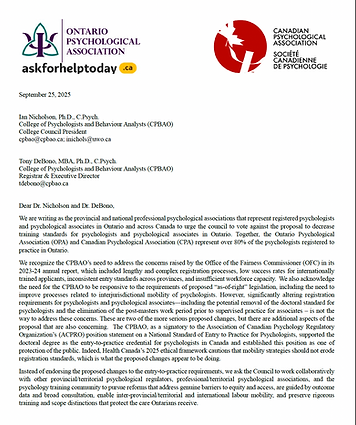
OPA and CPA Letter
In a joint letter, the OPA and CPA urged the CPBAO Council to reject the proposed reductions to psychology training and licensing requirements. Their letter states that lowering standards would harm public safety, contradict national regulatory commitments, and erode the quality of care Ontarians receive.
They emphasize that concerns raised by the OFC and labour-mobility goals can be addressed through streamlined processes, harmonized standards, and system reforms without dismantling long-standing safeguards that protect patients.

CPA Position Statement
The CPA calls for a harmonized, doctoral-level national entry standard for psychologists across Canada, arguing that inconsistent provincial requirements confuse the public, restrict access to care, and impede labour mobility.
Dr. James McKillop et al. (2025) Study
Professor at McMaster University, Canada Research Chair
Clinical Psychologist and Director at McMaster University and St. Joseph’s Healthcare Hamilton
A new study led by Dr. James MacKillop, surveyed 1,141 Ontario adults to understand public views on the CPBAO’s proposal to lower psychologist training standards.
The findings were clear:
-
71% of Ontarians disapprove of the changes
-
Only 9% approve
People were most worried about:
-
Reduced quality of care
-
More undertrained providers
-
Higher risk of misdiagnosis
-
Greater danger in high-stakes contexts (e.g., hospitals, forensic settings, complex diagnoses)

Collectively, the results suggest strong disapproval for the proposed reductions in psychologist entry to practice criteria.
“We don't need fewer professional standards--we need highly skilled professionals to deal with an increasing complex world.”
Dr. Jonathan Weiss
Clinical Psychologist and Professor at York University
Dr. Weiss authored a detailed analysis of the College of Psychologists and Behaviour Analysts of Ontario (CPBAO) Council’s proposed Registration Modernization changes. The analysis situates these proposed reforms within the College’s mandate to protect the public by ensuring that only qualified, competent, and ethical professionals are authorized to practice psychology in Ontario.
Visit his website for more details on the analysis, or click the image to download.

Open Letter
Signatures needed from Canadian psychologists & graduate students
In response to these changes, psychologists from across Canada have come together to draft an Open Letter calling on the CPBAO to reconsider this direction and instead pursue modernized pathways that protect the public, respect national regulatory alignment, and ensure meaningful access to high-quality psychological care. This initiative reflects a united commitment to maintaining safe, rigorous training that support the diverse clinical, research, and assessment roles that psychologists fulfill in health-care and community settings.
The deadline to sign is December 3, 2025. This letter can only be signed by graduate students in psychology at any level and individuals registered to practice as psychologists in their province or territory.

Lead signatory & coordinating author:
Dr. Nicolás F. Narvaez Linares, C. Psych
Clinical Neuropsychologist
Clinical & School Psychologist
Letters of support from Organizations
Letter of support from the American Academy of Clinical Neuropsychology
\
- Dominic A. Carone, PhD, ABPP-CN
President of the AACN
Questions related to this letter of support can be directed Dr. Carone (dcaronephd@gmail.com) or Dr. MacKillop (emily.mackillop@gmail.com)
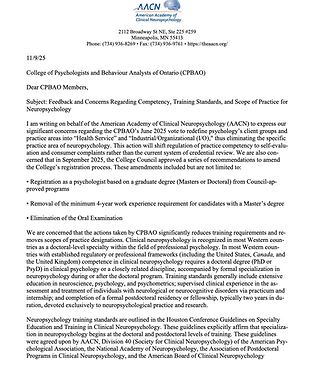
"We are concerned that the actions taken by CPBAO significantly reduces training requirements and re-moves scopes of practice designations."
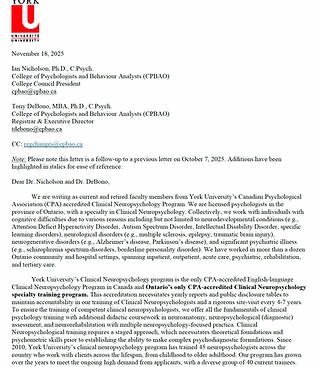
Letter of support from current and retired faculty members from York University’s Canadian Psychological Association (CPA) accredited Clinical Neuropsychology Program.
"We urge CPBAO to reconsider the erasure of clinical neuropsychology as a specific practice area. This critical service area requires a specialized designation to safeguardthe public, including some of society’s most vulnerable individuals with significant cognitive and functional impairments."
The Canadian Council of Professional Psychology Programs (CCPPP) represents the various university-based psychology programs and psychology residency settings in Canada that train professional psychologists such as clinical psychologists, counselling psychologists, and clinical neuropsychologists, as well as other branches of professional psychology.
CCPPP wrote a position statement urging the CPBAO to reverse its proposed registration changes, warning they drastically reduce training, supervision, and accreditation standards needed to safely practice as a psychologist. CCPPP argues the proposals eliminate essential safeguards, weaken public protection, and may actually reduce access to high-quality psychological services. They call for maintaining accreditation, preserving robust supervision and exams, and working toward national standards that improve access without compromising competency.

PAN Survey Results
The Psychology Advocacy Network polled 1,275 Ontario psychologists, psychological associates, students and trainees about their views on the College of Psychologists and Behaviour Analysts of Ontario’s (CPBAO) proposed amendments.
Download full report here.

